
January 15, 2026
A new kind of training ground has emerged among the heart of Phuket’s thriving business market. Sim Racing is what we are talking about!
For high-performing professionals in Phuket like entrepreneurs, executives, traders, athletes, and creatives, the real differentiator is cognitive resilience. As a result, decision-making speed, emotional regulation under pressure, sustained focus, and adaptability has become survival tools.
While meditation apps, brain-training games, and productivity tools promise sharper thinking, few deliver meaningful, transferable results. This is where sim racing emerges as a powerful and often underestimated performance accelerator.
This guide focuses on the practical payoff — how sim racing sharpens the focus, reaction time and composure that matter on and off the track.
Every lap on the simulator engages the same neural circuits as real driving — visual processing, split-second decisions, and fine motor control all working together under pressure. Repeated over time, that focused effort is what sharpens reactions and builds mental stamina. This post focuses on what those gains mean for you in practice; for the full brain science, read the deep dive.
For the complete neuroscience, see sim racing as cognitive training.
The cognitive demands of sim racing mirror the high-stakes decision-making that Phuket’s business leaders face daily, but with one crucial advantage: immediate, consequence-free feedback. When you misjudge a braking point into Turn 1, you experience the consequences instantly. When you maintain composure during a chaotic first lap, you’re rewarded with track position and momentum.
This rapid feedback loop accelerates learning in ways that traditional business simulations simply cannot replicate. Your brain doesn’t distinguish between the pressure of defending a position from an aggressive competitor and the pressure of negotiating a critical deal. Both activate the same neural networks responsible for focus, decision-making under stress, and emotional regulation.
The difference? In the simulator, you can experience hundreds of these high-pressure moments in a single afternoon, building mental resilience through repetition rather than waiting for monthly board meetings or quarterly presentations!
High-performers across industries speak reverently about “flow state”, that elusive mental zone where performance becomes effortless and time seems to distort. Flow states are characterized by complete absorption in the task, optimal challenge-skill balance, and peak cognitive function.
Sim racing is essentially a flow state generator. The constant stream of challenges, the immediate feedback, the clear goals, and the perfect balance between difficulty and skill create ideal conditions for entering flow.
What many don’t realize is that flow states are trainable. Each time you enter flow in the simulator, you’re teaching your brain the neural pathways to access that state more readily. This translates directly to your professional life.
One of the most valuable cognitive skills developed through sim racing is advanced pattern recognition. Professional drivers don’t consciously think through every corner, their brains recognize patterns and execute learned responses automatically, freeing up mental bandwidth for higher-level strategy.
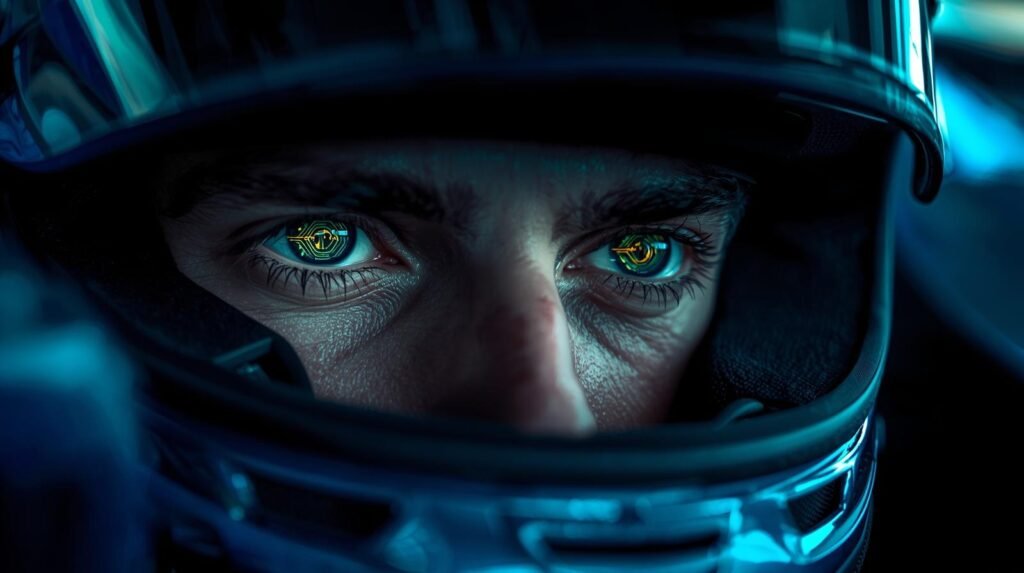
This pattern recognition ability is precisely what separates exceptional business leaders from average ones. The ability to quickly identify market patterns, recognize emerging trends, and spot opportunities that others miss is fundamentally about neural pattern recognition, the exact skill you’re developing every time you learn a new circuit or adapt to changing track conditions.
At SIMPRO Academy, you will be training your brain to identify complex patterns faster, to recognize subtle changes in dynamic systems, and to anticipate future states based on current information. These are precisely the cognitive abilities that drive success in financial markets, strategic planning, and competitive business environments.
Here’s something that might surprise you: elite sim racers are just better at rapid task-switching and prioritization, not better multitaskers. During a race, one rapidly switches focus between competing demands with such fluidity that it appears simultaneous.
This distinction matters because effective multitasking is actually about knowing what deserves your attention at each micro-moment. Should you focus on the car ahead or the gap to the car behind? Is this the lap to push or to conserve?
These split-second prioritization decisions build executive function, your brain’s CEO, in ways that translate directly to managing multiple projects, leading teams, and balancing competing business priorities.
Unlike brain-training apps that operate purely in the digital realm, sim racing engages your entire body. The physical feedback through force-feedback wheels, the G-forces simulated through motion platforms, the brake pedal pressure, all of this creates what neuroscientists call embodied cognition.
Your brain doesn’t learn abstract concepts as effectively as it learns things tied to physical experiences. When you feel the wheels lock under heavy braking, when you sense the car beginning to understeer, when you physically correct a slide, you’re creating multi-sensory memory traces that are far more robust and transferable than purely cognitive learning.
This embodied learning explains why sim racing skills often transfer unexpectedly to other domains. The confidence you build controlling a high-performance machine under pressure doesn’t stay confined to racing, as it influences how you carry yourself in boardrooms, how you navigate challenging conversations, and how you approach uncertainty.
What sets SIMPRO Academy apart in Phuket’s wellness and performance landscape is the recognition that sim racing is about unlocking human potential. The facility combines professional-grade equipment with an understanding of how to structure sessions for cognitive development rather than just entertainment.
Whether you’re a CEO seeking to sharpen decision-making skills, an entrepreneur building mental resilience, or a professional looking to enhance focus and concentration, SIMPRO offers a unique training environment where the pursuit of faster lap times becomes a vehicle for comprehensive cognitive enhancement.
In a world where mental performance increasingly determines professional success, the most effective training tools often come from unexpected places. For Phuket’s high-performers, that place might just be behind the wheel of a racing simulator, where every lap builds not just driving skill, but the cognitive capabilities that drive success in every domain of life.
Answer: Most brain-training apps isolate single cognitive functions in low-pressure environments. Sim racing, by contrast, activates multiple cognitive systems simultaneously, like attention, reaction, strategy, emotional control, under real-time stress. This mirrors how the brain actually functions in high-stakes professional and competitive situations, making the training far more transferable to real life.
Answer: Yes. Sim racing trains your nervous system to stay calm while processing complex information quickly. Over time, participants report improved composure, clearer thinking, and faster decision-making during high-pressure meetings, negotiations, and presentations. The brain learns that pressure does not equal panic.
Answer: SIMPRO sessions build core cognitive skills such as processing speed, spatial awareness, working memory, focus, executive decision-making, and pattern recognition. Participants also develop psychological resilience, staying composed under pressure, recovering quickly from setbacks, and sustaining concentration. Most importantly, SIMPRO training helps individuals access flow states on demand, driving peak performance in business, leadership, and personal growth.
Answer: No. Mental fatigue is a sign that your brain has been challenged effectively. Just like physical fatigue after a gym workout, it indicates growth and adaptation. With consistent training, recovery becomes faster and overall cognitive endurance improves.
Written by Paul Chappell — owner-operator of SIMPRO Academy Phuket, a professional airline pilot of 23+ years and qualified flight instructor, and a lifelong motorsport enthusiast with thousands of hours in full-motion simulators. He coaches every discipline at SIMPRO personally.
Leave a Comment: