
February 23, 2026

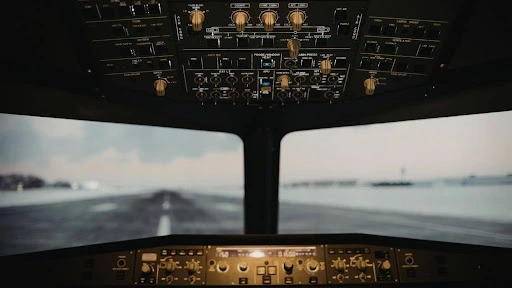
A trainee once asked during an interview at Simpro Academy Phuket, “Why does the simulator feel different from the aircraft?” – it’s a fair question. One may ask such a question regarding flight simulators, which are built to reproduce aircraft systems, cockpit procedures, and emergency scenarios. These are engineered with precision, yet many pilots still feel a gap between real flight and simulation training in Phuket environments.
Here, you need to understand that frustration does not mean simulators fail. It usually points to deeper technical factors such as control loading, visual cues, latency, and cockpit workflow. If you perceive these factors in the first step, you can witness an improvement in the overall flight simulator experience in Phuket. Thus, you can give rise to a more effective learning environment.
Come, let’s discuss when the cockpit does not feel right in flight simulation in Phuket.
One of the most prevailing complaints from trainees is simple: “The controls don’t feel alive.”
You may find that in real aircraft, forces on the control stick or yoke change with airspeed, trim, and aerodynamic load. If a simulator has weak force feedback or poorly tuned control loading, the pilot may struggle to perceive pitch stability or roll response.
Here lies the magic of the modern simulation training system. This simulation training in Phuket systems tries to resolve the issue using calibrated control hardware, advanced flight models, and detailed aerodynamic data. You can understand that our primary service focuses on flight simulation experiences for beginners and aviation enthusiasts. When the significant elements are tuned correctly, the simulator starts to mirror real cockpit behaviour far more closely.

If you want to know why frustration appears when visual cues do not match pilot input, focus on this reflection. Even a small delay between control movement and screen response is impactful for situational awareness.
During approach training, for instance, the pilot relies on runway alignment, glide slope perception, and peripheral motion to maintain stability. If frame rates drop or projection systems lag, the brain observes the mismatch instantly. This is why modern facilities that offer flight simulation Phuket prioritize the high refresh visuals, synchronized displays, and stable processing systems.
At Simpro Academy Phuket, instructors often remind trainees that simulators are curated for systems training and decision practice, not only for motion sensation. A pilot might say that the aircraft would feel different in real turbulence,” and the instructor may respond:
“Yes, but the checklist discipline and procedure timing must still be exact.”
By focusing on cockpit workflow, radio calls, emergency drills, and instrument scanning, simulation becomes a structured learning tool. Over time, pilots begin to see that the simulator is not replacing flight but preparing the mind for it. Thus, you may observe that our primary service prioritizes flight simulation experiences that are highly impactful.
Do you know how trust grows among us? Trust grows when the simulator behaves predictably. For this, you need:
These attributes help pilots rely on the system. When that trust is built, frustration slowly turns into focus. This is the real goal of a virtual flight experience in the Phuket environment. The simulator should challenge the pilot, reveal mistakes safely, and allow repetition of complex procedures such as carrier approach profiles, navigation alignment, or emergency engine management.
Why do professional pilots often find flight simulators frustrating compared to real-world flying?
Because small differences in motion cues, control loading, and visual timing can break the sense of realism for experienced pilots.
What are the most common technical glitches in flight simulator training?
Input latency, frame rate drops, miscalibrated controls, and unstable software are among the most common issues.
How can flight schools improve the “immersion factor” to reduce pilot pushback?
Better visual systems, realistic control feedback, structured scenarios, and clear instructor guidance can significantly increase immersion.
Is VR Virtual Reality, more effective than traditional fixed-base simulators for pilot training?
VR can enhance visual immersion, but well-calibrated fixed-base simulators still provide stronger procedural training reliability.
Can simulator frustration lead to “negative transfer” in actual flight?
Yes, if the simulator behaviour differs too much from real aircraft dynamics, pilots may develop incorrect control expectations.
Are you ready to bridge the gap? If you have ever stepped out of a simulator thinking something felt slightly wrong, you are not alone.
The real value of modern training lies in the refinement of the system until pilots trust what they feel and observe. At Simpro Academy Phuket, each session is built to close that gap. Witness a flight simulation Phuket environment or flight simulation experiences where precision, procedure, and learning come together to build confident decision-making for future-ready pilots today.
Leave a Comment: