

Airlines worldwide are short more than 12,000 cockpit crew in 2026, and the Asia-Pacific region — where the airline fleet is forecast to triple by 2043 — is the single hottest market for new pilots in the world. If you’ve ever wondered whether now is the right time to start, the answer is yes, and the data is the loudest it has been in my 23 years in aviation.
This guide lays out the realistic pathway from your first procedural simulator session to your first day in the right seat of a regional jet. We’ll cover what each licence stage actually requires, which sim hours count toward your total, where the Asia-Pacific cadet programs are, what new First Officers actually earn, and — honestly — which aviation careers most people overlook even though they pay just as well as flying for a major carrier.
Most importantly, you do not need to commit to flight school before you sit in a cockpit. A 60-minute Discovery Flight Sim session at SIMPRO Academy Phuket lets you find out whether the cockpit feels like home before you spend a baht on training. Many of the trainees I’ve coached over the years made their decision in exactly that 60 minutes.
Why 2026 Is the Most Opportunity-Rich Year for New Pilots in a Generation
The global pilot shortage is not a forecast anymore — it is the current operating reality. IATA and Boeing’s Commercial Market Outlook both project that more than 600,000 new pilots will be needed worldwide by 2042, with the Asia-Pacific region accounting for the largest single share.
Three forces are converging in 2026:
- Fleet growth: Asia-Pacific airlines are placing record narrowbody orders. AirAsia, IndiGo, VietJet, Lion Group, and Bamboo Airways have all expanded order books for delivery between 2026 and 2030.
- Retirement wave: Pilots who entered the industry in the late 1990s and early 2000s are now hitting mandatory retirement age (60 in most jurisdictions, 65 with multi-pilot crew under ICAO).
- Training pipeline gaps: COVID hollowed out flight schools between 2020 and 2022. The pilots who should have been First Officers in 2025–2026 simply weren’t trained on time.
If you start procedural simulator training this year and progress on a typical ab-initio timeline, you can realistically be in the right seat of a regional jet by 2030. That is not optimistic. That is how the math actually works once you understand the licence stack.
The Realistic Pathway: PPL → CPL → ATPL → First Officer
A common misconception is that becoming an airline pilot takes a decade. It doesn’t — not anymore. Below is the actual licensing stack and a realistic timeline if you train full-time.
| License | Min Flight Hours | What You Can Do | Typical Duration | Sim Hours That Count |
|---|---|---|---|---|
| PPL (Private) | 40–45 hrs | Fly single-engine aircraft for personal use, daytime VFR | 4–8 months full-time | Up to 5 hrs on approved FNPT |
| IR (Instrument Rating) | +50 hrs IFR | Fly in clouds, low visibility, controlled airspace | 3–6 months | Up to 40 hrs on FNPT II / FFS |
| CPL (Commercial) | 200 hrs total | Fly for hire — flight instruction, charter, surveying | 12–18 months full-time | Up to 10 hrs (CAAT/FAA); 5 hrs (EASA Modular) |
| MEP (Multi-Engine) | +6 hrs ME | Fly multi-engine aircraft | 1–2 weeks | Procedural sim widely used |
| ATPL Frozen | 14 theory exams + CPL/IR/ME | First Officer eligible on airliners | Sit theory in parallel — 6–12 months | Full FFS used for Type Rating |
| ATPL Unfrozen | 1,500 hrs total | Captain eligible on airliners | 4–8 years of airline flying | Recurrent FFS every 6 months |
Hour minimums shown are ICAO baseline values. Specific civil aviation authorities (CAAT Thailand, EASA, FAA, CAAS Singapore, DGCA India) apply additional requirements.
The non-obvious insight is the last column: simulator hours count toward your licence at every stage, and the better-equipped the simulator, the more they count. That is the lever that makes a faster timeline possible.
Asia-Pacific Cadet Programs in 2026
A cadet program is the fastest legitimate route from zero hours to a First Officer seat. Some are fully sponsored; some require you to fund part of the course; almost all involve a bond commitment to fly for the sponsoring airline for 5–10 years after graduation.
| Cadet Program | Length | Cost Structure | Eligibility | Where to Apply |
|---|---|---|---|---|
| AirAsia Cadet Program (Thailand & ASEAN) | ~18 months | Self-funded with airline-backed financing | 18+, high-school complete, ASEAN nationals | AirAsia careers portal |
| Bangkok Airways Pilot Cadet | ~24 months | Bond-based, partly subsidised | Thai nationals, university degree preferred | Bangkok Airways HR |
| Cathay Pacific Cadet (Hong Kong) | ~55 weeks | Fully sponsored | 18+, HK residency or PR | Cathay Pacific careers |
| Singapore Airlines Future Pilot | ~22 months | Fully sponsored + bond | 21+, degree, Singapore citizen | SIA careers |
| IndiGo Cadet Pilot Programme (India) | ~20 months | Self-funded ~INR 1.1–1.5 crore | 18+, 12th-grade physics/maths | IndiGo cadets portal |
| Emirates Cadet Pilot Programme (UAE) | ~24 months | Fully sponsored + bond | UAE national; expanding to expats in 2026 | Emirates careers |
Always verify the latest eligibility, cost, and bond terms with the airline directly — programs update annually.
How Simulator Hours Actually Count Toward Your Licence
Three civil aviation authorities cover most readers of this blog. Each treats simulator credit slightly differently, and getting this right matters because every simulator hour you legally substitute for aircraft time is around 4,000–6,000 THB you don’t have to spend.
CAAT (Thailand)
Under the Civil Aviation Authority of Thailand regulations, simulator hours on an approved FNPT (Flight and Navigation Procedures Trainer) can be credited toward both PPL and CPL hour requirements, subject to the specific approval level of the device.
EASA (Europe)
Under EASA Part-FCL, FNPT II credit toward CPL Modular is capped at 5 hours; toward the IR, up to 40 hours of procedural simulator time may be credited. ATPL Modular allows up to 100 hours of simulator credit in the integrated route.
FAA (United States)
FAA 14 CFR Part 61 and Part 141 schools allow varying degrees of credit. Under Part 61, up to 2.5 hours of simulator time can count toward Private Pilot; up to 50 hours toward Commercial. Part 141 schools can credit more, depending on the specific simulator’s level (FTD vs FFS).
This is one of the reasons procedural training in a quality simulator is not a luxury — it’s part of the licensing strategy. The procedural muscle memory you build in a simulator transfers directly into the aircraft, and the hours you log are recognised credit, not just practice.
of those constraints. More importantly, the simulator can do things the aircraft can’t — repeatedly, safely, and on demand:
- Engine failure on takeoff. You can practice the abandon decision, the rotation-or-stop call, and the post-airborne flow ten times in a session. You can’t do that in a real aircraft without risking the aircraft.
- Loss of all electrical, partial-panel flight, runaway trim, and other ‘I hope this never happens to me’ scenarios — repeated until the response is automatic.
- Crosswind landings beyond your personal comfort zone, in a controlled environment, with the option to reset and try again.
- Procedural flows — pre-flight, before-takeoff, climb checklist, cruise checklist, descent planning, approach briefing — practiced to the point of automaticity before you ever burn aviation fuel.
- Instrument scanning under simulated IMC (instrument meteorological conditions) on any approach, at any airfield in the world, in any weather you choose.
In 23 years of flight training and as a Chief Pilot, I can tell you the trainees who do procedural simulator work between aircraft lessons progress visibly faster than the ones who don’t. It isn’t even close.
What New Pilots Actually Earn
Salary expectations are one of the questions trainees are most reluctant to ask. They shouldn’t be. Here are realistic 2026 ranges by region.
| Region | First Officer (year 1) | Captain (5+ years) |
|---|---|---|
| Thailand (Thai Lion, Nok, Bangkok Airways) | ~80,000–130,000 THB/month | ~250,000–400,000 THB/month |
| Singapore / Hong Kong | ~SGD 7,000–10,000/month | ~SGD 18,000–25,000/month |
| Middle East (Emirates, Qatar) | ~USD 8,000–11,000/month tax-free + housing | ~USD 16,000–22,000/month tax-free + housing |
| Europe (Ryanair, easyJet, Lufthansa) | ~EUR 3,500–6,000/month | ~EUR 12,000–18,000/month |
| United States (regional + majors) | ~USD 90,000–110,000/year (regional) | ~USD 250,000–400,000/year (majors) |
Figures are typical ranges as of 2026. Vary by aircraft type, seniority, fleet, currency exchange rates, and contract terms.
The Middle East and US major-airline numbers will look striking compared to Thailand. They are. But the cost of training also varies dramatically by jurisdiction — a self-funded Thai CPL is significantly cheaper than its European or US equivalent — and the path from First Officer to Captain in a fast-growing Asian carrier can be measurably faster than in a saturated Western market.
5 Aviation Careers Beyond Airline Pilot
If your first answer to ‘what kind of pilot do you want to be?’ is ‘airline,’ the second answer worth considering is anything else. The non-airline routes are less competitive, often pay surprisingly well, and start producing income much faster.
1. Corporate / Business Jet Pilot
Flying corporate jets — Bombardier Globals, Gulfstreams, Dassault Falcons — for private owners, charter operators, and fractional companies. The lifestyle is unpredictable but the type-rating and command opportunities arrive years earlier than in airlines.
2. Flight Instructor (CFI/CFII/MEI)
Many First Officers built their hours flight-instructing. It pays modestly but it builds command authority and teaches you to teach — a career-long skill. In Asia-Pacific, flight instructor demand is roughly as acute as airline pilot demand.
3. Cargo / Freight Pilot
FedEx, UPS, Atlas Air, Cathay Cargo, K-Mile Air. Night flying, predictable rosters, often higher pay than passenger equivalents at junior levels.
4. Aerial Survey, Mapping, and Special Operations
LiDAR survey, agricultural spraying, pipeline inspection, aerial photography. Specialised, low-altitude, high-skill flying that builds an unusual logbook fast.
5. Ferry Pilot
Delivering aircraft across continents. Niche and irregular but legendary for the experience curve. Most ferry pilots start by being known in the industry — which begins, as everything in aviation does, with a logbook full of clean simulator and aircraft hours.
Your Next Step: A 60-Minute Discovery Flight Sim Session
Flight school is a serious commitment of time and money. A simulator session is not. Before you put 4–8 months into PPL training, find out whether the cockpit is where you want to spend the next 30 years.
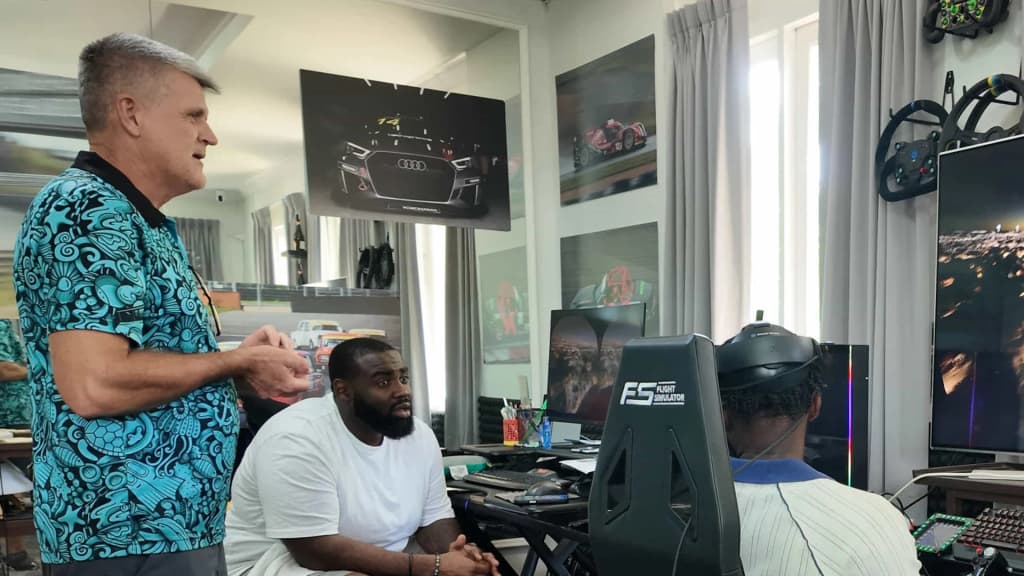
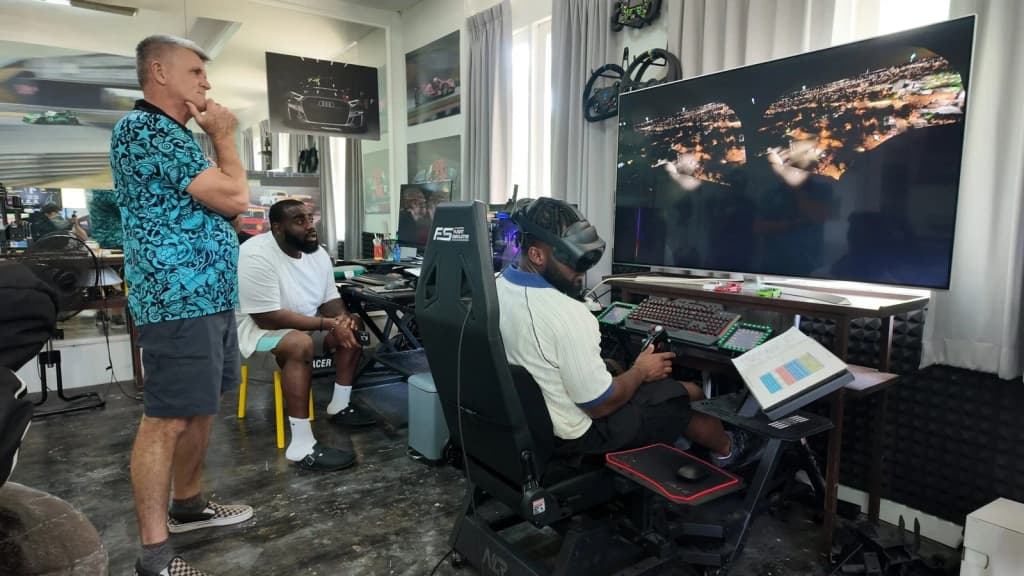
At SIMPRO Academy Phuket, our Discovery Flight Sim Session is structured as 5 minutes of pre-flight briefing, 60 minutes of guided flying — typically a VFR circuit at Phuket International (VTSP), a short coastal tour toward Patong, and a return landing on runway 09 — and 10 minutes of debrief. You will handle the controls. Your instructor will handle the radios and the workload management while you concentrate on the flying. By the end, you’ll know.
Step into the cockpit before you commit to the cost.
A 60-minute Discovery Flight Sim session at SIMPRO Academy Phuket is the simplest way to find out if a flying career suits you — before you spend a baht on flight school.
1,300 THB / 60 minutes · +66 62 962 2822 · info@simproacademyphuket.com
Includes 7% Thai VAT and 3% booking fee.
Related Reading at SIMPRO
- PPL/CPL Procedural Training at SIMPRO Academy Phuket — what a procedural sim session actually looks like.
- Addressing Pilot Frustrations with Flight Simulation Training — honest answers to the questions most trainees won’t ask out loud.
- Flight Simulation Basics: Your First Flight — what to expect in your first 60-minute discovery session.
- Type Rating 101 (coming soon) — what happens when an airline puts you in a Full Flight Simulator.
Sources
- Boeing Commercial Market Outlook — 600,000+ new pilots needed by 2042
- IATA Industry Forecast — Asia-Pacific aviation growth
- CAAT (Civil Aviation Authority of Thailand) — Part-FCL simulator credit rules
- EASA Part-FCL — European simulator credit limits
- FAA 14 CFR Part 61 and Part 141 — US simulator credit rules
- AirAsia, Bangkok Airways, Cathay Pacific, Singapore Airlines, IndiGo, Emirates — public cadet program information
About the Author
Paul Chappell is Founder and Operator of SIMPRO Academy Phuket. With 23+ years as a professional airline pilot, including a Lead Captain position on a Boeing Business Jet where he managed flight training and checking responsibilities, Paul brings deep expertise in precision performance and simulator-based training. He has previously operated as a qualified flight instructor and has logged hundreds of hours on certified full-motion flight simulators.
Beyond aviation, Paul is a lifelong motorsport enthusiast — 10+ years on high-performance motorbikes, multiple track days in an AMG 45S, a professional rally driver training course, and extensive experience on high-performance go-karts. He founded SIMPRO Academy in 2024 to bring professional-grade sim racing and flight simulation training to Southeast Asia.