
February 5, 2026
Technological progress in the modern scenario has brought so many changes to the table that modern simulation technology has moved far beyond simple steering inputs and screen visuals. At advanced training centers such as Simpro Academy Phuket, the focus is placed on precision, telemetry, and mechanical feedback that mirrors real vehicle behaviour.
Now, let’s find out one of the most significant technologies that’s behind this realism. And that is the direct-drive force feedback system. Instead of relying on belts or gears, torque is delivered directly from the motor to the steering shaft.
Within SIMPRO’s high-end simulators Thailand training environment, every steering input is translated through potential direct drive bases, as it can communicate grip levels, weight transfer, and tire behaviour. Are you unsure about the results? The result is not entertainment, but a structured simulation system engineered for performance improvement.
In traditional belt-driven systems, force from the motor passes through belts or pulleys, which can soften or delay the feedback. However, direct-drive technology connects the steering wheel straight to a high-torque servo motor. As there are fewer mechanical intermediaries, telemetry-based signals are delivered immediately. Now, you may ask,
“How does this precision allow the drivers to sense microtraction loss, surface vibration, and steering resistance?”
These features are observed with impressive accuracy. Come, let’s delve deeper into that in the next section.
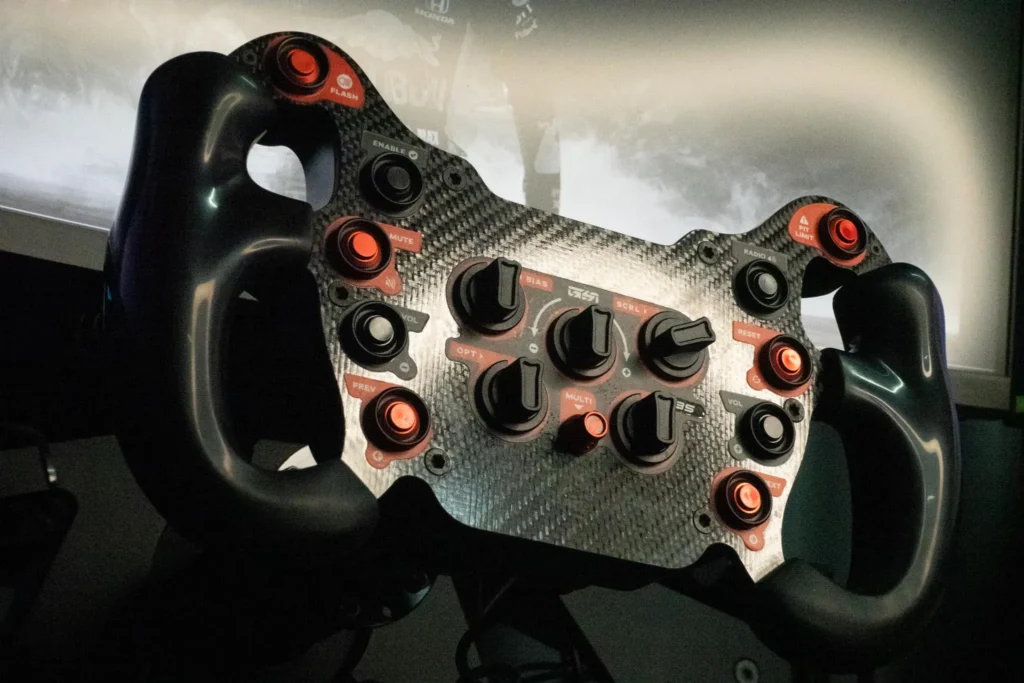
If you follow the technological progress for quite a certain period of time, you can perceive that modern simulators depend heavily on telemetry. This captures real-time information such as tire slip, suspension load, steering angle, and vehicle balance. You can figure out that
Within SIMPRO’s system, this data is processed by simulation software and translated into physical torque on the wheel. Over time, steering discipline and reaction speed are naturally reinforced.
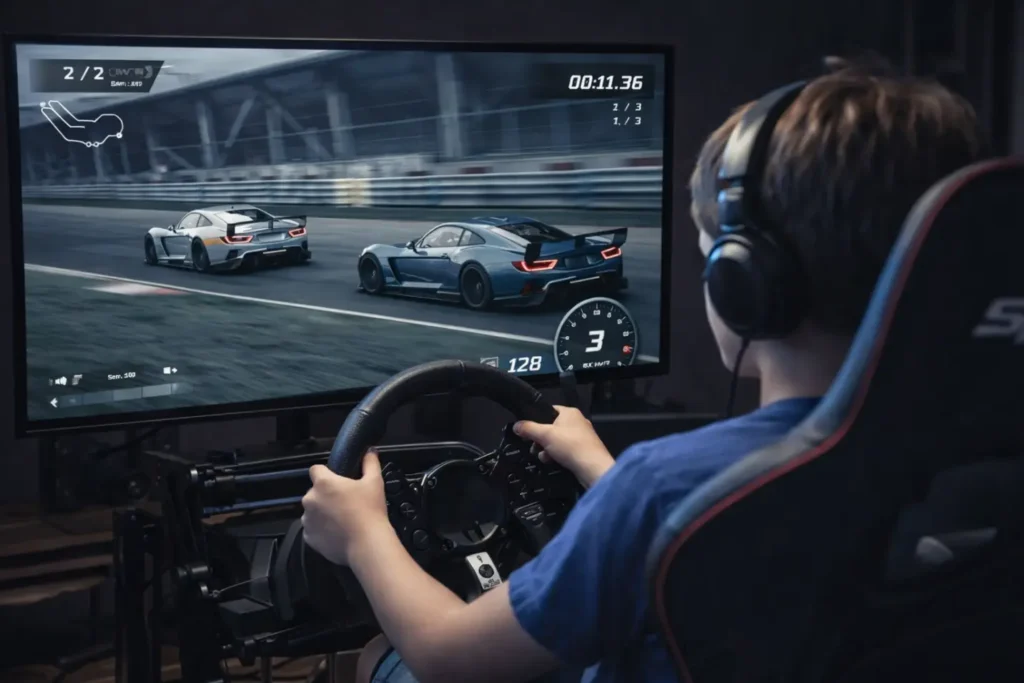
Want to know how a professional simulator center trains nowadays? Here it is.
Training at a professional simulator center is structured in order to enhance focus as well as consistency. At facilities utilising high-end simulators in Thailand, engineered sessions are sometimes guided by telemetry analysis and coaching. Participants learn how traction changes appear through steering torque rather than visual cues alone.
Even different activities like a gokart Phuket track session, particularly with electric go-karts Phuket, are approached as a simulation experience where technique and vehicle balance can be observed.
An offline racing simulator environment cuts down distractions and gives rise to a focused learning space. How is the offline racing simulator able to do that? With the help of:
These attributes make sure that every session remains consistent.
Because the Direct Drive system creates detailed steering forces, muscle memory can gradually be improved. Drivers start to recognize traction thresholds earlier, which leads to smoother inputs and developed vehicle stability.
Direct Drive systems transmit torque directly from the motor to the steering shaft, while belt-driven systems use belts that slightly remove feedback precision.
Telemetry signals from the simulator software are turned into torque outputs by the direct-drive motor, which allows steering resistance to reflect real-time vehicle dynamics.
Yes, detailed telemetry allows the system to reproduce surface vibration, traction loss, and tire slip through steering feedback.
Balanced force scaling, controlled damping, and accurate telemetry filtering are generally recommended to maintain clear traction signals.
While not mandatory, direct drive systems provide significantly clearer feedback that helps drivers refine steering precision and consistency.
If you want to understand how advanced simulation technology sharpens driving awareness, a structured session at Simpro Academy Phuket offers the opportunity to observe direct drive precision firsthand.
Enter a controlled training environment, study telemetry in detail, and explore how refined steering feedback can evolve your perception or insights regarding traction, control, and performance. The next level of simulation training may begin with a single session behind the wheel. Keep in mind that curiosity often becomes skill when technology and coaching go hand-in-hand, and that journey is awaiting those ready to explore deeper steering intelligence and disciplined vehicle control today at SIMPRO Academy.
Leave a Comment: